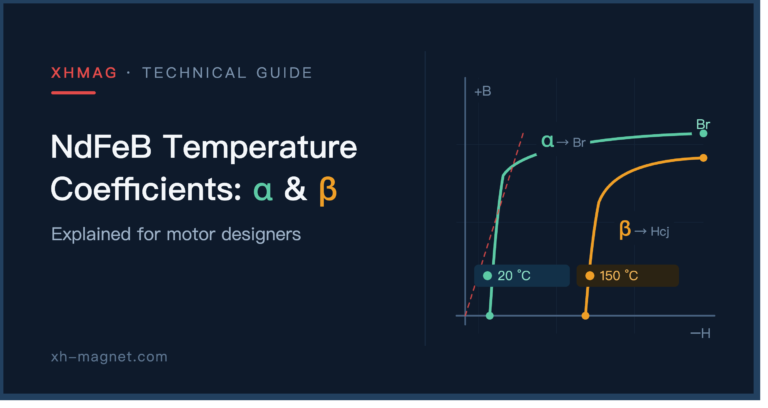

Coercivity (Hcj) is what keeps a permanent magnet stable when the temperature climbs. In a traction motor at 150 °C, or a servo running continuously under load, it is the intrinsic coercivity — not the remanence — that decides whether the magnet holds its magnetization or begins to demagnetize. For decades, the only dependable way to raise Hcj in sintered NdFeB was to alloy dysprosium (Dy) or terbium (Tb) into the bulk of the material. That route works, but it is expensive, supply-constrained, and now subject to export licensing in the country that produces most of the world’s heavy rare earth.
Grain boundary diffusion (GBD) changes the equation. By placing heavy rare earth precisely where coercivity is won — and, in the most advanced grades, by replacing it with light-rare-earth and non-magnetic boundary phases — GBD delivers the thermal stability of a high-Hcj grade with a fraction of the heavy rare earth, and in a growing range of grades with none at all. This article explains the mechanism, the microstructure behind it, and how our engineering team uses it to supply Dy/Tb-free grades that ship under standard export procedure.
Coercivity is a grain-surface problem
To understand why GBD works, it helps to know where coercivity comes from. The hard magnetic phase in a sintered NdFeB magnet is the Nd₂Fe₁₄B grain. Its ability to resist reverse magnetization is governed by magnetocrystalline anisotropy — but in a real sintered body, the magnet almost never reaches its theoretical coercivity. Reverse magnetic domains nucleate first at the grain surfaces and grain boundaries, where the local anisotropy is weakened by lattice defects, stray phases, and misaligned neighboring grains.
In other words, coercivity is lost at the grain periphery, not in the grain core. This single fact is the foundation of GBD. The interior of each Nd₂Fe₁₄B grain does very little to set the coercivity; the thin outer layer does almost all of it. Traditional bulk alloying distributes Dy or Tb uniformly through the whole grain, which means most of the expensive heavy rare earth is spent in a region — the grain core — where it produces no coercivity benefit and actively reduces remanence.
Why heavy rare earth raises Hcj — and what it costs
Dy and Tb work because their (Dy,Fe) and (Tb,Fe) analogues of the Nd₂Fe₁₄B structure have far higher magnetocrystalline anisotropy fields. Where Nd₂Fe₁₄B has an anisotropy field of roughly 7.5 T, Dy₂Fe₁₄B sits near 15 T and Tb₂Fe₁₄B near 22 T. Substituting these elements into the crystal lattice therefore raises the field required to nucleate reverse domains — a direct Hcj gain.
The penalty is twofold. First, Dy and Tb couple antiferromagnetically with iron, so every atom substituted into the lattice reduces the net magnetization; remanence (Br) and maximum energy product (BH)max fall. Second, heavy rare earth is scarce and volatile in price, and shipments of Dy- and Tb-bearing material are now caught by dual-use export controls that add licensing time to every order. Bulk alloying maximizes both penalties by spreading heavy rare earth everywhere.
How grain boundary diffusion works
GBD attacks the problem geometrically. A heavy-rare-earth source — typically a metal, fluoride (DyF₃ or TbF₃), hydride, or alloy — is applied to the surface of a finished sintered magnet. The part is then annealed below its sintering temperature, commonly in the region of 850–950 °C, followed by a lower-temperature aging step near 500 °C.
The key is the Nd-rich intergranular phase. This phase softens and becomes partially liquid well below 900 °C, forming a continuous network of channels along the grain boundaries. During the diffusion anneal, Dy or Tb migrates inward through this network rather than through the grain interiors, which stay solid. The heavy rare earth deposits along the grain surfaces and forms a thin (Dy,Nd)₂Fe₁₄B or (Tb,Nd)₂Fe₁₄B shell around each Nd₂Fe₁₄B grain.
The core–shell microstructure: high Hcj, preserved Br
The result is a core–shell grain structure. The shell is enriched in heavy rare earth and carries the high anisotropy exactly where reverse domains would otherwise nucleate. The core remains Dy/Tb-free, so it retains the full magnetization of standard Nd₂Fe₁₄B.
This is why GBD is more efficient than bulk alloying on both counts. Because the heavy rare earth is concentrated in the shell — the region that actually governs coercivity — a large Hcj gain, often several hundred kA/m (on the order of 2–6 kOe for thin geometries), is achieved with a much smaller quantity of Dy or Tb. And because the grain cores are untouched, the loss in Br and (BH)max is far smaller than the equivalent bulk-alloyed grade. In practice, matching the coercivity of a bulk-alloyed grade through GBD can cut heavy-rare-earth consumption by well over half.
Going further: high Hcj without any Dy/Tb
Classic GBD reduces heavy rare earth dramatically, but the same grain boundary engineering platform also opens a route to zero Dy/Tb. High coercivity is fundamentally about isolating and protecting grains, and several levers do this without any heavy rare earth at all:
- Grain refinement. Coercivity rises as grain size falls. Reducing the sintered grain size from the conventional 5–10 µm toward the low-micron range — through optimized jet milling and controlled powder handling — raises Hcj directly by shrinking the nucleation volume within each grain.
- Grain boundary phase optimization. Additions of Cu, Al, Ga, and related elements form a continuous, weakly magnetic intergranular phase that magnetically decouples adjacent grains and smooths the boundaries where reverse domains would nucleate. Better isolation means higher Hcj at the same composition.
- Light-rare-earth diffusion. Diffusing Nd–Cu, Pr–Cu, or Nd–Al eutectic alloys into the grain boundaries repairs and wets the boundary network without introducing any heavy rare earth. This raises Hcj through the same core–shell logic as heavy GBD, but with light rare earth only.
Combined, these techniques deliver the elevated coercivity that a wide range of automotive, industrial, and consumer applications require — entirely without Dy or Tb. The highest-temperature grades (the UH, EH, and AH classes) may still call for a minimal, GBD-concentrated heavy-rare-earth addition, but the great majority of demanding designs can now be served by Dy/Tb-free grain boundary engineering.
Design limits worth knowing
GBD is a diffusion process, so its reach is finite. Effective enhancement extends only a few millimeters inward from the treated surface, which means GBD delivers the most uniform benefit on magnets that are thin in the diffusion direction — commonly up to around 5–6 mm, and further with optimized processing. For thick blocks, the center of the part receives less enhancement than the surface. Understanding this constraint early lets us match the grade, geometry, and process to the working point of your circuit rather than over-specifying material.
Why this matters commercially
The engineering advantage of grain boundary engineering translates into a direct supply-chain advantage. Grades built without Dy or Tb are not subject to the dual-use export licensing that now governs heavy-rare-earth-bearing material, so they ship under standard export procedure. For our customers, that means a predictable lead time of 25–30 days rather than an open-ended wait on a permit, along with insulation from the price volatility that follows every heavy-rare-earth supply shock.
Grain boundary diffusion, in short, is not just a way to save dysprosium — it is the foundation of a magnet portfolio that decouples high-temperature performance from the most constrained corner of the rare-earth market. If you are specifying NdFeB for a motor, actuator, or sensor that must hold coercivity at temperature, our engineering team can help you identify the Dy/Tb-free grade and geometry that meet your working point.
Talk to our engineering team about Dy/Tb-free NdFeB grades and grain boundary diffusion options for your application.
contact XHMAG (昕徽磁业) at tony@xh-magnet.com.