Introduction
On April 4, 2025, China’s Ministry of Commerce issued Announcement No. 18, imposing export licensing requirements on seven medium and heavy rare earth elements and all products derived from them, including finished permanent magnets. The regulation took effect immediately.
For R&D engineers who need to specify the appropriate magnet grades and for procurement managers who handle supplier relationships, the practical consequences are clear: longer lead times, higher costs, and additional documentation requirements. This applies to a type of material that most teams hadn’t previously considered to be a compliance issue.
This article is structured to address the questions that procurement and engineering teams actually need to answer. The order of the sections is as follows: What exactly is being controlled? Does this regulation apply to my particular situation? What has changed regarding supply and pricing since April 2025? What are my practical options?
Part 1: What MOFCOM Announcement No. 18 Covers
The Controlled Elements
The April 2025 controls apply to seven medium and heavy rare earth elements (MREEs/HREEs) and all associated metals, oxides, alloys, compounds, and downstream products:
- Samarium (Sm)
- Gadolinium (Gd)
- Terbium (Tb)
- Dysprosium (Dy)
- Lutetium (Lu)
- Scandium (Sc)
- Yttrium (Y)
The controls are issued under China’s Export Control Law and its regulations on dual-use items — the same legal category used internationally for materials and technologies with both civilian and defense-relevant applications. NdFeB magnets containing dysprosium or terbium are used in EV traction motors and industrial servo systems, but the same high-coercivity, high-temperature-stable grades also appear in defense electromechanical systems, which is the basis for the dual-use classification. The practical takeaway for commercial buyers: end-use documentation now matters in a way it did not before April 2025.
Which Magnet Types Are Affected
| Magnet Type | Export License Required? | Notes |
|---|---|---|
| All SmCo magnets | Yes | All grades contain samarium |
| Sintered NdFeB with Dy or Tb | Yes | Including grain boundary diffusion grades |
| Sintered NdFeB with Gd | Yes | Gd is a controlled element |
| Sintered NdFeB (Dy/Tb/Gd-free) | No | Light REE only; freely exportable |
| Bonded NdFeB (no HREE) | No | Unaffected |
The key commercial distinction: standard sintered NdFeB grades made from neodymium, praseodymium, lanthanum, and cerium do not require a license. The controls apply specifically to grades where dysprosium or terbium is added — either as a bulk alloying element or via grain boundary diffusion — to enhance coercivity and high-temperature stability.
In grade terms, this generally maps to performance tier: high-coercivity grades (e.g., N42SH, N38UH and above, or anything rated for continuous operation above roughly 120°C) typically contain Dy or Tb and fall under the controls. Standard grades for ambient or moderate-temperature use generally do not.
The Licensing Process
To export a controlled magnet, the Chinese exporter applies to MOFCOM for a shipment-specific license. Each application requires:
- An end-user certificate identifying the buyer and the intended application
- A technical description of the product, including composition and grade designation
- Importer identification and documentation
- Full value-chain documentation tracing the material from production to end use
There is no statutory processing deadline. Approval timelines since April 2025 have ranged from roughly 45 days to several months. Applications with complete, clearly civilian end-use documentation are generally processed, though not on a predictable schedule. Applications with vague end-use descriptions, or anything that could be read as defense-adjacent, face extended review.
Part 2: Does This Apply to Your Application?
Before deciding on a response strategy, the first question is whether your specific use case is actually in scope. This varies significantly by application.
Electric motors and drives. Servo motors and traction motors operating continuously above ~120°C typically specify high-coercivity grades with Dy or Tb content, which fall under the controls. Motors designed for ambient or moderate-temperature operation may be achievable with standard N35–N45 grades without HREE content, depending on torque density and demagnetization margin requirements.
Sensors and sensing systems. Position sensors, Hall-effect assemblies, and magnetic encoders generally use small quantities of standard sintered NdFeB and are often outside the scope of the controls. Sensors specified with high-coercivity grades for thermally demanding environments are the exception and should be checked individually.
Hand tools and power tools. Permanent magnet motors in cordless tools typically operate at moderate temperatures using standard NdFeB grades and are usually unaffected. SmCo magnets, used in some specialist tool applications, are controlled regardless of grade.
Wind energy and EV traction. These sectors have the most direct exposure. Direct-drive wind generators and EV traction motors are among the largest consumers of high-coercivity, HREE-containing sintered NdFeB, and supply planning here has changed the most since April 2025.
If your application falls in the affected category, the question becomes whether the grade can be substituted (Part 4) or whether you need to plan around the licensing process (also Part 4). If it falls outside the controls, the main action is to document that fact clearly for your own compliance records, since suppliers and customs authorities may still ask.
Part 3: What Has Happened to Supply and Pricing Since April 2025
Immediate Disruption: April–June 2025
Chinese exports of controlled rare earth materials and magnets fell sharply in April and May 2025 as the licensing infrastructure was established and an initial backlog of applications accumulated. Some European and U.S. manufacturers reported production disruptions due to magnet shortages in Q2 2025.
Price dislocation was significant. According to IEA analysis, European import prices for dysprosium and terbium reached up to six times their Chinese domestic equivalent at the peak of the disruption in mid-2025.
Where the Market Stands in Mid-2026
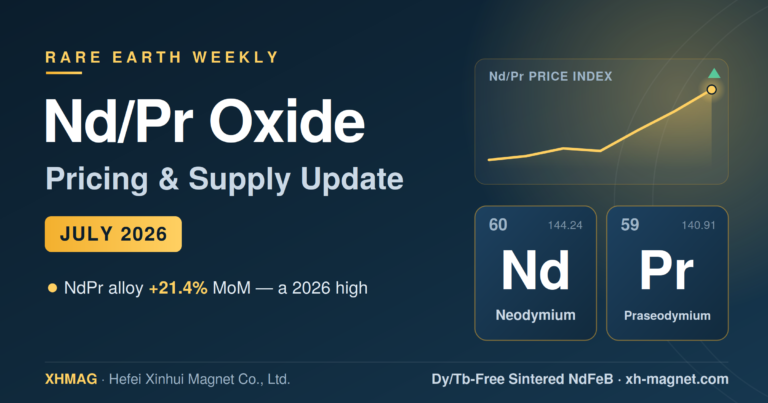
The license regime has now been operational for over a year. Processing timelines remain variable but have become somewhat more predictable for well-documented commercial applications, generally settling into a 60–120 day range — roughly double or triple pre-2025 norms.
The domestic/export price gap persists. As of March 2026:
| Material | China Domestic | FOB China |
|---|---|---|
| Neodymium oxide | ~$113/kg | ~$184/kg |
| Dysprosium oxide | ~$190/kg | ~$317/kg |
| Terbium oxide | ~$804/kg | ~$1,182/kg |
These differentials reflect the structural effect of licensing friction on traded volumes rather than any single short-term market event, and they have compressed cost competitiveness for manufacturers sourcing controlled-grade magnets outside China.
Part 4: Practical Response Options
Step 1: Audit Current Grade Specifications for HREE Content
Request explicit composition disclosure from your supplier, including whether GBD (grain boundary diffusion) processing introduces any controlled elements even if the bulk alloy is HREE-free. If your current grade is confirmed HREE-free, your supply chain is not directly affected — document this for internal compliance records.
Step 2: Evaluate HREE-Free Grade Substitution
Where your current grade does contain Dy, Tb, or Gd, engineering evaluation of HREE-free alternatives is now commercially worth doing. Advances in grain boundary diffusion and powder metallurgy have produced Dy-free and Tb-free sintered NdFeB grades with room-temperature magnetic properties comparable to conventional grades. The trade-off is reduced high-temperature coercivity above roughly 100–120°C, so the right test is demagnetization curve analysis against your specific operating point, not a general performance comparison.
Where substitution is technically viable, the advantages are direct: no export license or associated lead time, standard shipping timelines, and typically 15–30% lower material cost from eliminating Dy/Tb inputs.
Step 3: Plan Lead Times and Safety Stock for Grades That Still Require HREE Content
Where substitution is not viable for thermal or performance reasons, procurement planning should budget 60–120 days for licensed deliveries from Chinese suppliers, with safety stock in the range of 90–180 days’ consumption for critical production programs. Just-in-time procurement is not a workable model for controlled-grade magnets sourced from China under the current regime.
Step 4: Prioritize Documentation Quality for Licensed Shipments
A significant share of licensing delays trace to incomplete or ambiguous application paperwork rather than to policy concerns about the buyer or application. Processing time can be reduced by ensuring the end-use certificate specifies product type, application, industry, and final market; that grade designation and composition are unambiguous; and that anything resembling a defense or aerospace use case is accompanied by clear civilian documentation. Working with a Chinese exporter that has an established MOFCOM track record since April 2025 is a practical efficiency measure.
Step 5: Build Optionality Into the Light Rare Earth Supply Chain
For neodymium and praseodymium — the light rare earth inputs that make up the bulk of NdFeB composition — non-Chinese supply capacity is growing, with Lynas Rare Earths (Malaysia/Australia), MP Materials (Mountain Pass, California), and Neo Performance Materials (Silmet, Estonia) active as alternative suppliers. This does not resolve HREE supply constraints, but it reduces concentration risk on the light REE side. For dysprosium and terbium specifically, non-Chinese separation capacity remains limited through at least 2026–2027; treat any near-term diversification claims in this segment conservatively.
Outlook
The April 2025 controls are established regulatory policy operating under China’s Export Control Law, not a temporary administrative measure. Planning assumptions that anticipate automatic normalization are not well-supported by the current regulatory framework.
The underlying structural position is straightforward: China accounts for approximately 60% of global mining output of magnet rare earths, roughly 90% of separation and refining capacity, and an estimated 90–94% of finished sintered NdFeB magnet production globally. This concentration developed over several decades of capital investment and industrial specialization, and meaningful diversification of the upstream supply chain typically requires 5–10 years from project initiation to commercial production for mining and separation assets.
For engineering and procurement teams, the practical planning horizon is clear: the licensing regime for HREE-containing magnets and all SmCo magnets is the operating environment for at least the next several years. Strategies that reduce or eliminate HREE dependency — through grade substitution, design adjustment, or alternative sourcing — compound in value over that period.
Frequently Asked Questions
Q: Does MOFCOM Announcement No. 18 apply to all NdFeB magnets?
No. Only NdFeB magnets containing dysprosium (Dy), terbium (Tb), or gadolinium (Gd) require an export license. Standard sintered NdFeB grades produced from neodymium, praseodymium, lanthanum, and cerium are not controlled.
Q: How do I know if my current magnet grade contains controlled elements?
Request a composition certificate or material disclosure from your supplier. Pay particular attention to whether GBD processing introduces Dy or Tb, since this is sometimes not reflected in the commercial grade designation. All SmCo grades require a license regardless of the specific cobalt-to-samarium ratio.
Q: What is a realistic lead time for licensed magnet shipments?
Under normal conditions with complete documentation, 60–90 days from order placement is a reasonable planning estimate. Applications that are incomplete or involve end uses subject to additional scrutiny may take considerably longer. There is no statutory deadline on MOFCOM processing.
Q: Can HREE-free NdFeB magnets match the performance of Dy-containing grades?
At room temperature and moderate operating temperatures (below approximately 100–120°C), HREE-free sintered NdFeB grades now achieve magnetic properties comparable to many conventional Dy-containing grades. Above this range, the coercivity advantage of Dy or Tb becomes significant. The right test is demagnetization curve analysis against your specific application load line, not a general comparison.
Q: What documentation should accompany HREE-free magnets at customs?
HREE-free sintered NdFeB magnets do not require an export license. Standard commercial documentation applies — commercial invoice, packing list, and a material composition certificate confirming the absence of controlled elements. Random customs inspection may still occur but does not reflect a licensing issue.
Summary
Whether the April 2025 controls affect your supply chain comes down to a single technical question: does your magnet specification contain dysprosium, terbium, or gadolinium? If not, your supply chain is largely unaffected by Announcement No. 18, regardless of industry. If it does, the controls are a stable operating constraint rather than a temporary disruption — licensed shipments will continue to run 60–120 days with real variability, and the price gap between Chinese domestic and export material is structural, not seasonal.
For most motor, sensor, and tool applications operating below roughly 120°C, this makes grade substitution to HREE-free sintered NdFeB the most practical response: it removes the licensing dependency entirely and typically lowers material cost. Where high-temperature performance genuinely requires Dy or Tb, the priority shifts to building licensing lead time and documentation quality into standard procurement planning, since the regulatory framework shows no indication of near-term change.
For composition certificates, product datasheets, or technical inquiries regarding HREE-free sintered NdFeB grades, contact XHMAG (昕徽磁业) at tony@xh-magnet.com.