Elevator traction motors run continuously, often in mechanically demanding environments with elevated ambient temperatures and strict duty cycles. For engineers specifying permanent magnets — and for procurement teams sourcing NdFeB materials — the wrong grade choice translates directly into demagnetization risk, warranty failures, and costly field replacements.
This guide covers the critical parameters for selecting sintered NdFeB magnets in elevator traction motor applications: grade designations, thermal stability considerations, surface protection, and what buyers in Europe, North America, and Asia need to know about compliance and export documentation.
1. Why Elevator Traction Motors Demand Careful Magnet Selection
Elevator traction motors — particularly the gearless permanent magnet synchronous motors (PMSMs) used in modern high-rise installations — subject magnets to a combination of stresses that few other applications match:
- Continuous or near-continuous duty cycles with minimal thermal recovery time
- Operating temperatures in motor housings that regularly reach 120–180°C
- High peak torque demands during acceleration and braking
- Long service life expectations (15–25 years) with minimal maintenance access
Standard consumer-grade NdFeB (e.g., N42 or N45 without temperature-rated suffixes) is insufficient for these conditions. The correct starting point is always the maximum continuous operating temperature of the motor housing — not the ambient installation temperature.
2. Understanding NdFeB Grade Designations for Motor Applications
Sintered NdFeB grades are expressed as a number-letter combination. The number reflects the maximum energy product (BHmax, in MGOe), while the suffix letter indicates the coercivity and thermal tolerance class:
Grade Suffix Reference:
- M (Medium): operating temp. 100°C | Hcj ≥ 17 kOe
- H (High): operating temp. 120°C | Hcj ≥ 20 kOe
- SH (Super High): operating temp. 150°C | Hcj ≥ 25 kOe
- UH (Ultra High): operating temp. 180°C | Hcj ≥ 30 kOe
- EH (Extremely High): operating temp. 200°C | Hcj ≥ 35 kOe
For elevator traction motors, SH and UH grades are the most commonly specified. EH grades are reserved for demanding applications where continuous winding temperatures exceed 180°C.
Recommended Grades by Application Type
|
Grade |
Br (kGs) | Hcj (kOe) | Max. Op. Temp. | Recommended Use |
|
N42M |
13.0–13.4 | 17–21 | 100°C | Low-speed, light-duty elevators |
|
N38SH |
12.3–12.8 | 25–28 | 150°C | Mid-range traction motors, standard duty |
|
N35UH |
11.8–12.3 | 30–35 | 180°C | High-load, high-cycle traction motors |
|
N33EH |
11.4–11.9 | 35–38 | 200°C | Extreme-duty, high-speed gearless systems |
Note: All values are typical ranges per IEC 60404-8-1. Actual performance depends on magnet geometry and operating conditions. Request a Magnetic Performance Data Sheet for specific lot verification.
3. Thermal Stability: The Critical Specification Buyers Often Overlook
Remanence (Br) and intrinsic coercivity (Hcj) both decrease with rising temperature. For traction motor magnets, the relevant parameters are:
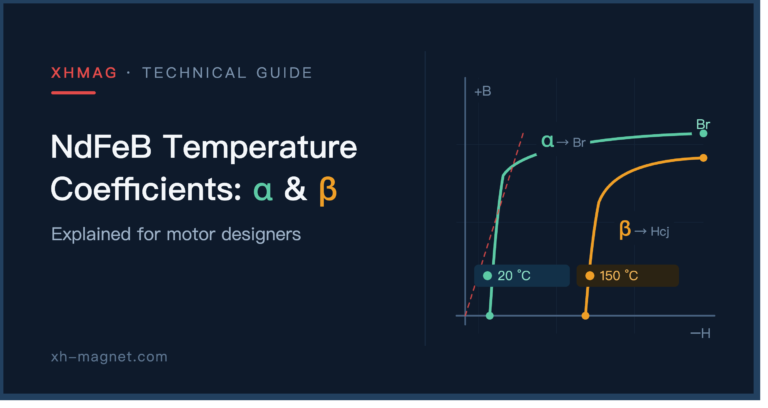
- Reversible temperature coefficient of Br (αBr): typically -0.11 to -0.13 %/°C for NdFeB
- Reversible temperature coefficient of Hcj (βHcj): typically -0.55 to -0.65 %/°C
- Irreversible flux loss threshold: the temperature at which demagnetization becomes permanent
What this means practically: an N42M magnet operating at 120°C will have already lost approximately 10–11% of its room-temperature Br — potentially enough to fall below the motor designer’s minimum flux density requirement. This is why specifying the correct thermal suffix is not optional.
Dy-Free Grades: A Note on Coercivity Trade-offs
Dysprosium (Dy) additions increase Hcj significantly, enabling higher operating temperatures. However, Dy is expensive, subject to supply volatility, and — critically for European buyers — Dy-containing alloys can trigger dual-use export licensing requirements in China.
Many mid-range elevator motor specifications (up to 150°C) can be met with Dy-free N38SH or N35SH grades, offering a cost advantage and simpler export documentation. Confirm this directly with your motor design team before substituting.
4. Surface Coating Selection for Long-Term Reliability
NdFeB is intrinsically corrosion-prone. For elevator traction motors installed in building shafts — which can experience humidity variation, condensation cycles, and occasional oil exposure — coating selection significantly affects magnet service life.
|
Coating |
Corrosion Resistance | Temp. Tolerance | Typical Application |
| Ni-Cu-Ni | Good | Up to 200°C |
General traction motors, dry environments |
|
Epoxy |
Excellent | Up to 180°C | Humid or oil-exposed environments |
| Zn | Moderate | Up to 150°C |
Cost-sensitive, low-humidity applications |
| Ni+Epoxy | Superior | Up to 200°C |
Marine-adjacent or high-humidity installations |
For most standard elevator installations, Ni-Cu-Ni (triple-layer nickel) is the industry default. For installations in coastal climates, humid tropical environments, or where oil mist is present, epoxy or Ni+Epoxy dual-layer coatings are strongly recommended.
Coating thickness should be specified at ±5 μm tolerance and confirmed by cross-section metallographic inspection on first-article samples.
5. Key Dimensional and Tolerance Requirements
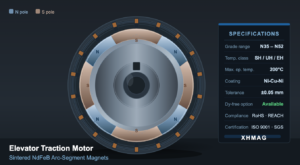
Elevator traction motors — particularly in gearless PMSM designs — use arc-segment or block magnets bonded directly to the rotor. Dimensional tolerances directly affect air gap consistency, motor efficiency, and assembly yield:
- Standard dimensional tolerance: ±0.05 mm on length/width, ±0.1 mm on height (sintered process)
- Flatness: ≤ 0.05 mm over the full face surface
- Perpendicularity: ≤ 0.1 mm per 50 mm
- Magnetization direction tolerance: ≤ 2° angular deviation from specified axis
- Chamfer/radius: specify minimum R0.3 mm or C0.3 mm to prevent chipping during assembly
For arc-segment magnets, inner radius (Ri), outer radius (Ro), and arc angle (θ) should all carry explicit tolerances on engineering drawings. Loose tolerances on Ro in particular create air gap variation that reduces motor efficiency.
6. Export Compliance and Documentation: What Buyers Need to Know
Sourcing NdFeB magnets from China involves regulatory considerations on both the export and import sides. Understanding these upfront prevents shipment delays.
HS Code Classification
- Sintered NdFeB magnets (magnetized): HS 8505.11.00
- Sintered NdFeB magnets (unmagnetized, rare earth): HS 8505.19.00
- Note: customs classification may vary by destination country — confirm with your freight forwarder
Chinese Export Licensing: Dy-Containing vs. Dy-Free
Magnets containing Dysprosium (Dy) or Terbium (Tb) may fall under China’s dual-use export control regulations, potentially requiring an export license and adding 4–8 weeks to lead times. Dy-free grades (achievable for many SH-class specifications) ship under standard commercial procedures without additional licensing.
Always confirm with your supplier whether the specified grade is Dy-free and request a material composition certificate if your compliance team requires documentation.
Import Compliance Requirements by Region
- EU (REACH/RoHS): NdFeB magnets must be RoHS 2 compliant. REACH SVHC declarations may be required for certain surface treatment chemicals. Request SGS or equivalent third-party test reports.
- Germany / Austria: DIN EN ISO 9001 quality system certification is frequently requested as a baseline supplier qualification requirement.
- USA: No specific rare earth magnet import license required, but TSCA compliance and country-of-origin marking (Made in China) must be observed.
- India: BIS certification is not currently required for industrial NdFeB magnets, but import duty (currently 7.5–10% on HS 8505) should be factored into landed cost calculations.
Shipping and Packaging Requirements
Magnetized NdFeB magnets are regulated as Class 9 dangerous goods (UN 2807) for air freight due to their magnetic field affecting aircraft instruments. For elevator motor magnets — which are typically large and strongly magnetized — sea freight with proper magnetic shielding packaging is the standard. Packaging must ensure the external magnetic field at 2.1 m distance is below 0.418 A/m (0.00525 gauss) to comply with IATA regulations for air.
7. Supplier Qualification Checklist for Procurement Teams
When evaluating NdFeB magnet suppliers for elevator motor applications, use the following as a baseline qualification framework:
- Quality system: ISO 9001:2015 certification (request certificate with valid scope and expiry)
- Environmental: ISO 14001 and REACH/RoHS compliance test reports from accredited labs (SGS, TÜV, Intertek)
- Magnetic performance: Lot-based Magnetic Performance Data Sheets with Br, Hcj, BHmax values and measurement conditions (temperature, magnetometer calibration date)
- Dimensional inspection: First Article Inspection (FAI) report with CMM measurement data
- Coating verification: Salt spray test (NSS) hours per ASTM B117 — minimum 48h for Ni, 96h for epoxy
- Thermal aging: Flux loss data after 1000h at rated operating temperature (irreversible loss < 5%)
- Export documentation: Commercial invoice, packing list, Certificate of Origin (Form A or RCEP as applicable), material composition certificate
8. Summary: Selecting the Right Grade for Your Application
For elevator traction motor sourcing, the decision framework is straightforward:
- Motor housing temperature ≤ 100°C: N42M or N38M — cost-effective, adequate for light-duty
- Motor housing temperature ≤ 150°C: N38SH or N35SH — the most common specification for standard commercial elevators
- Motor housing temperature ≤ 180°C: N35UH or N33UH — for high-performance gearless traction systems
- Motor housing temperature ≤ 200°C: N33EH — high-rise, extreme-duty applications
Specify coating based on installation environment (Ni-Cu-Ni for standard; epoxy or dual-layer for humid or coastal), confirm Dy-free availability if export licensing simplicity is a priority, and request first-article dimensional and magnetic inspection reports before committing to volume orders.
Request a Quote or Technical Consultation
XHMAG has supplied sintered NdFeB magnets to elevator and industrial motor manufacturers for many years. Our standard product range covers N35–N52 in M/H/SH/UH/EH grades, with Dy-free options available across most SH-class specifications. All products are manufactured under ISO 9001:2015 / ISO 14001 quality systems, with SGS-certified REACH and RoHS test reports available on request.
Send us your drawing or specification sheet for a grade recommendation and quotation within 24 hours.
Contact us:tony@xh-magnet.com