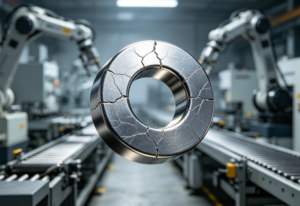
A cracked magnet on the line is one of the most expensive failures in motor, sensor, and power-tool production. It scraps the magnet, often the sub-assembly around it, and — when a crack passes inspection and ships — it becomes a field failure. If you build with sintered NdFeB and you’re seeing chips, hairline cracks, or split rings during assembly, the root cause is almost always the interaction between a brittle material and your assembly process, not a bad batch of magnets. This guide covers the seven causes we see most across European and US motor and sensor lines, and the design and process fixes that eliminate them.
First, understand why NdFeB is so brittle
Sintered NdFeB is an intermetallic compound (Nd₂Fe₁₄B) — closer to a technical ceramic than to a metal. It is exceptionally strong in compression but weak in tension and bending, with low fracture toughness. That asymmetry is the single most important fact for anyone assembling these magnets: any process that puts the magnet in tension, bending, or point-load impact is fighting the material’s weakest axis.
It’s also anisotropic, and the sintering and diamond-grinding process can leave microscopic surface cracks that act as stress risers long before you ever touch the part. Treat a finished NdFeB magnet the way you’d treat a pane of glass: immensely capable in the right loading direction, and unforgiving in the wrong one.
The 7 root causes of cracking during assembly
01.Press-fit and interference stress
Pressing a magnet into a slightly undersized bore puts the magnet in hoop tension — the exact load it is weakest against. Even a correctly toleranced interference fit can exceed the tensile limit at the bore wall. Rings and arcs are especially vulnerable because the tensile stress concentrates on the inner radius.
02.Magnetic snap impact
NdFeB is strong enough to pull itself out of an operator’s hand and slam into a steel pole or another magnet at speed. That impact is a point load with no compliance — it chips corners and starts hairline cracks that only open up later under thermal or mechanical cycling.
03.Adhesive cure shrinkage and missing bond gap
Bonding a magnet metal-to-metal with no controlled gap lets the adhesive cure-shrink and the housing clamp directly onto the part, putting it in tension. Stiff, brittle adhesives transmit every bit of that stress straight into the magnet instead of absorbing it.
04.Thermal stress from CTE mismatch
NdFeB has a low, anisotropic coefficient of thermal expansion, while steel and aluminium housings expand much more. During adhesive cure or thermal cycling in service, the housing grips or stretches the magnet. Over enough cycles, that differential expansion cracks the part.
05.Sharp edges and pre-existing chips
Square corners are stress concentrators, and the as-ground surface can already carry microcracks from diamond grinding. A sharp, chipped edge is a ready-made crack initiator — the assembly load just finishes what the grinding wheel started.
06.Hydrogen embrittlement from plating
Electroplated Ni-Cu-Ni coatings can introduce hydrogen into the magnet. Without a proper post-plating bake-out, that hydrogen embrittles the material, so a part that looks perfect cracks under loads it should easily survive.
07.Over-constraint and bending loads
Designs that locate a magnet on two faces and then clamp, or that let an assembly force act as a bending moment across a thin magnet, load the part as a beam. NdFeB has almost no bending tolerance — over-constraint is one of the most common designed-in causes of cracking.
How to fix it: design and process changes that work
You don’t need a more exotic magnet grade to stop cracking — you need to stop loading the material against its weak axis. In order of impact:
1.DESIGN
2.GEOMETRY
3.BONDING
4.HANDLING
5.THERMAL
6.COATING
7.SUPPLY
When to involve your magnet supplier — early
Most assembly cracks are designed in, not manufactured in, which means the cheapest place to solve them is before tooling is cut. A capable supplier should review your retention method, edge geometry, tolerance stack, and adhesive choice as part of design-for-manufacture — not just quote to a drawing. At XHMAG (昕徽磁业), our engineering team supports motor, sensor, and power-tool builders across Europe and North America with edge chamfering, tightened crack inspection, grade selection for mechanically demanding assemblies, and DfM review of the magnet–housing interface. If you’re fighting a recurring crack on the line, that’s exactly the conversation to start.
Frequently asked questions
Are NdFeB magnets more brittle than SmCo?
Both are brittle sintered materials, but they fail differently. SmCo is harder and even more notch-sensitive, while NdFeB is slightly tougher but still far weaker in tension than in compression. Neither tolerates bending or impact — the same design rules apply to both.
Can NdFeB magnets be machined to remove a crack?
No. Sintered NdFeB can only be ground with diamond tooling, and grinding a cracked magnet typically propagates the flaw rather than removing it. A cracked magnet should be scrapped, and the assembly process corrected so the next part doesn’t crack.
Does the coating prevent cracking?
Coatings protect against corrosion, not mechanical stress — a Ni-Cu-Ni or epoxy layer adds negligible strength. In fact, electroplating without a hydrogen bake-out can make a magnet more prone to cracking, not less.
What bond gap should I design for?
A controlled gap of roughly 0.05–0.15 mm suits most structural magnet adhesives. It gives the adhesive room to absorb cure shrinkage and CTE strain, and prevents the housing from clamping metal-to-metal onto the magnet. Confirm the exact value with your adhesive datasheet.
The bottom line
NdFeB cracking during assembly is a predictable, solvable problem. The material is brittle by nature, so the fix is rarely “buy better magnets” — it’s loading the magnet in compression, softening every impact and interference, chamfering edges, leaving a real bond gap, controlling thermal ramps, and specifying plating that won’t embrittle the part. Get those right and cracking moves from a recurring scrap line to a non-event. When you’re not sure where the stress is coming from, bring your supplier in early — it’s far cheaper than scrapping rotors.
XHMAG produces sintered NdFeB magnets with high quality. Full QC documentation — including salt spray test reports — with every shipment. Contact: tony@xh-magnet.com