The NdFeB demagnetization curve tells you everything your datasheet summary omits — how much flux you actually get, exactly where the magnet loses it permanently, and how that shifts at 120 °C. Here’s how to read every number on it.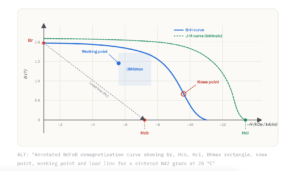
The demagnetization curve — the second quadrant of the B-H hysteresis loop — is the single most information-dense document your magnet supplier gives you. Yet many engineers rely on just two numbers from it: Br and Hci. That leaves the knee point, the (BH)max rectangle, the load line, and the intrinsic J-H curve unread. In practice, those are the numbers that determine whether your motor survives a fault current, a thermal excursion, or a decade of field service without irreversible flux loss. This guide walks through every feature of the NdFeB demagnetization curve and explains exactly what it means for motor, sensor, and actuator design.
What the NdFeB Demagnetization Curve Actually Show
A complete B-H loop has four quadrants. In normal use your magnet sits in the second quadrant, where the applied field opposes the magnetization. The demagnetization curve is that quadrant plotted alone, with field strength (H) increasing to the right on the horizontal axis and flux density (B) on the vertical axis.
Most datasheets overlay two curves: the B-H curve (extrinsic) and the J-H curve (intrinsic). They diverge at high demagnetizing fields and reading only one of them gives you an incomplete picture. The B-H curve tells you the total flux density; the J-H curve strips out the applied field contribution and shows the material’s own magnetization — crucial for predicting irreversible loss.
Br, Hcb, Hci, and (BH)max: What Each Number Means
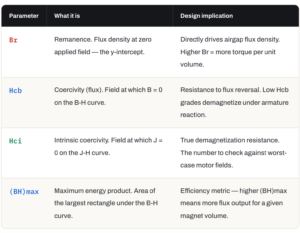
The grade number in NdFeB nomenclature (N42, N48SH…) encodes both parameters. The digits give the nominal (BH)max in MGOe; the suffix codes the Hci tier — standard (none), H, SH, UH, EH, AH — each with progressively higher coercivity and a proportionally lower Br due to dysprosium or terbium substitution.
The Knee Point on the NdFeB Demagnetization Curve: The Number That Matters Most
The knee point is where the B-H curve departs from linear. Above the knee, any demagnetizing event is fully reversible — remove the opposing field and the magnet recovers. Below the knee, the loss is permanent: flux density drops and never returns, even with the opposing field removed.
Standard-grade NdFeB (e.g. N42) has a high knee — sometimes above 0.8 T — at room temperature. At 120 °C the knee can climb past 1.0 T, meaning the linear operating region has dramatically shrunk. A magnet that is perfectly safe at 20 °C can be operating below its knee at motor operating temperature — a design error that appears as gradual, progressive flux loss in the field.
Rule of thumb:
Your working point must stay above the knee on the operating temperature curve — not the room-temperature curve. Verify this at Tmax before committing to a grade.
Load Line and Working Point: Where Your Magnet Actually Operates
The working point is where your magnet actually sits on the demagnetization curve in your specific circuit. It is determined by the permeance coefficient (Pc) — the ratio of B to µ₀H — which is set by the geometry of your magnetic circuit (airgap length, magnet length, cross-section ratios).
Draw a straight line from the origin of the B-H plot with slope Pc. Where it intersects the demagnetization curve is your working point. A short magnet with a large airgap gives a low Pc and a working point close to the knee — dangerous. A longer magnet or a smaller airgap raises Pc and pushes the working point safely into the linear region.
- Pc > 10: Working point high on the curve, far above the knee — typical of well-designed rotor magnets in IPM motors.
- Pc ≈ 3–5: Common in surface-mounted SPM motors. Adequate for standard grades; verify at Tmax with demagnetizing armature current.
- Pc < 2: Working point near or below the knee — high-coercivity grade (SH or UH) required, or geometry must change.
How Temperature Shifts the NdFeB Demagnetization Curve
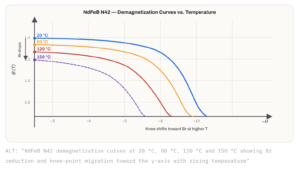
As temperature rises, two things happen simultaneously and both work against you:
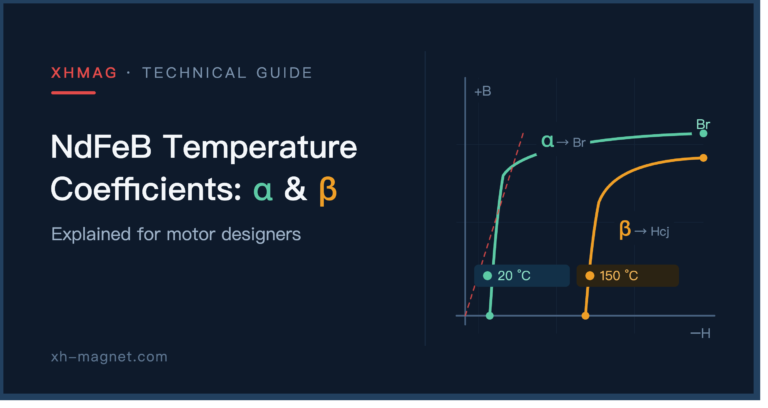
- Br decreases at a rate set by the reversible temperature coefficient α(Br), typically −0.09 to −0.12 %/°C for sintered NdFeB. Less remanence means less airgap flux and less torque.
- Hci decreases sharply — β(Hci) is typically −0.50 to −0.65 %/°C, five to six times faster than Br. The knee point migrates toward the y-axis, shrinking the safe operating window dramatically.
This is why a standard N42 grade can demagnetize in a motor that runs at 130 °C under a fault current, while an N42SH or N42UH — same Br at room temperature, much higher Hci — survives the same event. When sizing for a thermal application, always request the full family of curves at your operating temperature range, not just the 20 °C datasheet.
Using the NdFeB Demagnetization Curve for Motor Grade Selection
- N42–N52 Standard · ≤80 °C
Maximum flux density. Use only where operating temperature is modest and demagnetizing fields are low.
- N42H–N48H H-grade · ≤120 °C
Good balance of Br and Hci. Common in BLDC motors, servo motors and pumps with moderate thermal loads.
- N38SH–N45SH SH-grade · ≤150 °C
High coercivity for demanding thermal environments. Preferred for EV traction and industrial servo applications.
- N35UH–N42UH UH-grade · ≤180 °C
Maximum coercivity. High-temperature industrial, oil-field downhole tools, and aerospace actuators.
Grade selection is a trade-off: higher Hci suffix grades buy demagnetization resistance at the cost of lower Br and higher price (heavy rare-earth additions). The correct process is:
- Determine Tmax (coil + magnet thermal model, not just ambient).
- Calculate worst-case demagnetizing field Hdemag (full armature current short-circuit condition).
- Request the demagnetization curve at Tmax for candidate grades.
- Confirm working point stays above the knee at Tmax under Hdemag.
- Run a 50 °C margin — operating at the knee edge is not a safe design.

When to Ask Your Magnet Supplier for the Full Curve Package
A responsible supplier should provide — without being asked — the B-H and J-H curves at multiple temperatures spanning your operating range, not just a room-temperature summary table. If your current supplier’s datasheet shows only Br, Hci, (BH)max, and Hcb at 20 °C, you are missing the information you need to design reliably.
At XHMAG, we supply sintered NdFeB to motor, sensor, and power-tool manufacturers across Europe and North America with full demagnetization curve families at customer-specified temperature points, working-point analysis on request, and grade recommendations based on your actual circuit geometry — not just the catalogue.
FAQ: Reading the NdFeB B-H Demagnetization Curve
What is the difference between Hcb and Hci on the NdFeB demagnetization curve?
Hcb (coercivity of B) is where total flux density B reaches zero — the x-intercept of the B-H curve. Hci (intrinsic coercivity) is where the magnetization J reaches zero on the J-H curve. Hci is always larger than Hcb for NdFeB and is the correct parameter to check against demagnetizing fields in your motor circuit, because a magnet can lose B-curve flux well before its intrinsic magnetization collapses
Why does the NdFeB B-H curve knee point move with temperature?
Hci decreases at roughly −0.5 to −0.65 %/°C — far faster than Br drops. As Hci falls, the knee of the B-H curve moves toward the y-axis and rises toward higher B values. At elevated temperatures the straight-line operating region shrinks dramatically, leaving the working point dangerously close to — or below — the knee even if the design looked safe at room temperature.
How do I calculate the permeance coefficient for my application?
A first-order estimate is Pc ≈ (L_m / L_g) × (A_g / A_m), where L_m is magnet length in the magnetization direction, L_g is the airgap length, A_g is the airgap area, and A_m is the magnet pole area. For accurate values in complex geometries, use FEA. This gives you the slope of the load line on the demagnetization curve, which intersects it at your working point.
Can I use a higher-grade NdFeB (e.g. N52) to compensate for a thermally hostile environment?
No — higher energy-product grades achieve their elevated (BH)max through higher Br, which typically comes with lower Hci. An N52 at 120 °C will often have a higher knee point (worse operating margin) than an N42SH at the same temperature. Always compare the full operating-temperature curves, not just room-temperature headline numbers.
What does “irreversible flux loss” mean in practice for a motor?
If the working point drops below the knee — due to a high demagnetizing current pulse or thermal excursion — the magnet permanently loses some magnetization. After the event, the magnet returns to a lower point on the demagnetization curve. The motor then runs with reduced torque and back-EMF indefinitely, and the loss is not recoverable without remagnetization.
Conclusion
Reading the NdFeB demagnetization curve is a core motor engineering skill. Br tells you the flux potential; Hci tells you the resistance to losing it; the knee point tells you the boundary you must never cross in service; and the temperature family of curves tells you how all of those limits shift as your motor heats up. Build the habit of checking the working point against the operating-temperature curve — not the room-temperature datasheet number — and you will eliminate an entire class of progressive flux loss failures that are hard to diagnose once they are in the field. If your supplier cannot provide that data, find one who can.