Coating selection doesn’t get as much attention as grade selection, but it probably should. We’ve seen motor customers switch grades three times trying to solve a corrosion problem that was actually a coating issue all along. And we’ve seen the opposite — engineers specifying Parylene for an indoor application that would have been perfectly fine with NiCuNi at a fraction of the cost.
This guide covers the five coatings we work with most frequently, what each one is actually good for, and how to think about the tradeoffs.
Why Coating Matters More Than People Think
Sintered NdFeB is inherently vulnerable to corrosion. The material is porous, it contains iron, and without proper surface protection it will start oxidizing — which degrades magnetic performance and eventually causes physical deterioration.
The coating is your first line of defense. Get it wrong and you’re either overpaying for protection you don’t need, or watching your magnets fail in the field.
Here’s the other thing: coating affects more than corrosion resistance. It affects dimensional tolerance, surface hardness, adhesion behavior, and in motor applications — whether your coating survives the installation process.
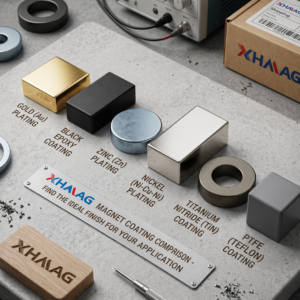
The Five Coatings
NiCuNi (Nickel-Copper-Nickel)
This is the default for a reason. NiCuNi is a three-layer electroplated coating — nickel, then copper, then nickel again — and it handles the majority of industrial applications without issue.
Salt spray performance: 72 hours standard. Higher with thicker plating.
What it’s good for: General industrial use, indoor environments, most motor applications, packaging closures, consumer products. If you’re not sure what coating you need, start here.
What to watch for: In motor assembly, we occasionally hear from customers that the NiCuNi layer has flaked or delaminated — usually when adhesive is involved in the installation, or when the rotor operates at high RPM and the coating experiences mechanical stress over time. In these cases, phosphate coating is worth considering instead (more on that below).
Not ideal for: Marine environments, prolonged outdoor exposure, or applications involving direct contact with certain chemicals.
Zinc (Zn)
Zinc is cheaper than NiCuNi and provides decent corrosion protection for the price — but it’s a step down in durability.
Salt spray performance: 24–48 hours typical.
What it’s good for: Cost-sensitive indoor applications, temporary assemblies, products where appearance matters less than price.
What to watch for: Zinc has lower surface hardness than NiCuNi, which means it scratches and chips more easily during handling. If your assembly process involves any mechanical contact — press-fit, sliding, or high-volume automated handling — zinc tends to show wear faster.
Not ideal for: Any application with humidity exposure, outdoor use, or where long service life is required.
Epoxy
Epoxy is a polymer coating applied over the magnet surface, typically after a base layer of NiCuNi or zinc phosphate. It gives good corrosion resistance with a smoother, lower-friction surface than electroplated coatings.
Salt spray performance: 48–96 hours depending on base coat and thickness.
What it’s good for: Applications where surface smoothness matters, environments with mild chemical exposure, situations where you want electrical insulation from the magnet surface, and some outdoor applications.
Practical note: Epoxy coatings are slightly more forgiving in press-fit assembly because the surface is harder to chip than nickel. Some motor customers prefer epoxy over NiCuNi for exactly this reason.
Not ideal for: High-temperature applications above 150°C — epoxy can degrade at elevated temperatures. Check the specific coating spec against your working temperature.
Phosphate (Phosphating)
This one doesn’t come up in most coating comparison articles, but it should — especially for motor applications.
Phosphate is a chemical conversion coating rather than an electroplated layer. It forms a thin, tightly bonded crystalline structure on the magnet surface. Because it’s not a separate layer sitting on top of the magnet, it doesn’t peel or delaminate under mechanical stress.
What it’s good for: Motor rotor applications where adhesive bonding is involved. If your assembly process uses epoxy or structural adhesive to bond magnets to a rotor core, phosphate gives significantly better adhesion than NiCuNi. The crystalline surface structure creates a mechanical key for the adhesive, and because there’s no plating layer to fail, you don’t get the delamination issue that some customers report with NiCuNi at high RPM.
Corrosion resistance: Lower than NiCuNi on its own. Phosphate is typically used as a base coat combined with oil or wax impregnation, or as a pre-treatment before adhesive bonding. For applications where the magnet is fully encapsulated in adhesive, the corrosion protection comes from the adhesive itself rather than the coating.
Be honest about the tradeoff: If your motor operates in a humid or wet environment and the magnets aren’t fully encapsulated, phosphate alone isn’t enough. Discuss your specific working environment before making the switch.
Parylene
Parylene is a vapor-deposited polymer coating — completely different process from the others. It produces an extremely thin, pinhole-free conformal coating that covers the entire surface including edges, holes, and internal features.
Salt spray performance: 200+ hours. Exceptional barrier properties.
What it’s good for: Medical devices, precision sensors, applications requiring electrical insulation, environments with aggressive chemical exposure, and any situation where conventional coatings can’t provide reliable coverage due to complex geometry.
The honest downside: Cost. Parylene is significantly more expensive than the other options — the vapor deposition process requires specialized equipment and longer cycle times. We do it, but it’s not a coating we’d recommend unless the application genuinely requires it. For most industrial magnet applications, NiCuNi or epoxy will do the job at a fraction of the price.
Not ideal for: Cost-sensitive applications, high-volume production where unit economics matter, or anywhere that a simpler coating is adequate.
Quick Reference Table
| Coating | Salt Spray | Best For | Watch Out For | Relative Cost |
|---|---|---|---|---|
| NiCuNi | 72hr | General industrial, motors, packaging | Delamination with adhesive at high RPM | Low |
| Zinc | 24–48hr | Indoor, cost-sensitive | Low durability, scratches easily | Lowest |
| Epoxy | 48–96hr | Smooth surface, mild chemical exposure | Degrades above 150°C | Low–medium |
| Phosphate | Low (base coat) | Adhesive-bonded motor rotors | Not standalone for wet environments | Low |
| Parylene | 200hr+ | Medical, sensors, complex geometry | High cost | High |
How to Actually Choose
The honest answer is: there’s no single right coating. It depends on three things working together.
Working environment. Indoor, outdoor, marine, high temperature, chemical exposure — each changes the equation. A coating that works perfectly in a controlled factory environment may fail quickly in an outdoor wind turbine.
Assembly process. How is the magnet being installed? Press-fit, adhesive bonding, mechanical retention? Motor customers who use structural adhesive to bond rotor magnets should think carefully about whether NiCuNi is actually the right choice, or whether phosphate gives better long-term adhesion.
Service life requirements. A magnet in a consumer product that gets replaced every two years has different requirements than a rotor magnet in an industrial motor expected to run for 20 years.
When customers ask us for a coating recommendation, we ask these three questions before making a suggestion. The grade might be straightforward, but the coating is often where the real engineering conversation happens.
A Note on Tolerance
One thing that’s easy to overlook: coating adds thickness. NiCuNi typically adds 10–20 microns per side. If you’re working with tight dimensional tolerances — say ±0.02mm — the coating thickness needs to be factored into your drawing spec. This is especially relevant for press-fit applications where the coated dimension is what matters, not the bare magnet dimension.
If you’ve had fitment issues and you’re not sure whether it’s a magnet problem or a coating problem, it’s worth checking whether the coating thickness was accounted for in the original spec.
Summary
For most applications, NiCuNi is the right starting point. It’s well-understood, durable, and cost-effective. Move to epoxy if you need smoother surface or mild chemical resistance. Consider phosphate if you’re bonding with adhesive in a motor application and have had delamination issues. Use Parylene when nothing else is adequate and the application justifies the cost.
If you’re specifying a coating for a new application and want a second opinion, send us the working environment, assembly method, and service life requirement. We’ll give you a straight answer.
XHMAG produces sintered NdFeB magnets with NiCuNi, Zinc, Epoxy, Phosphate, and Parylene coating options. Full QC documentation — including salt spray test reports — with every shipment. Contact: tony@xh-magnet.com