If you’ve been sourcing NdFeB magnets from China for any length of time, you already know that lead times can be unpredictable. What changed in April 2025 is different — it’s not a capacity issue or a logistics delay. It’s a policy change that has permanently altered how certain grades get exported, and a lot of buyers found out about it the hard way.
Here’s what actually happened, what it means for your procurement, and what you can do about it.
What Changed
On April 5, 2025, China started enforcing export license requirements for NdFeB magnets containing dysprosium (Dy) or terbium (Tb). These are the heavy rare earth elements added to high-temperature grades to achieve the coercivity needed for demanding motor applications.
The licenses fall under China’s dual-use export control regime, administered by MOFCOM. In practice, this means your Chinese supplier cannot ship Dy/Tb-containing grades without an approved export permit — and getting that permit takes time. A lot of time.
We’re talking 12 weeks minimum. Sometimes longer. And there’s no guarantee of approval.
For supply chains that were running on 25–30 day lead times, this is a serious disruption.
Which Grades Are Actually Affected
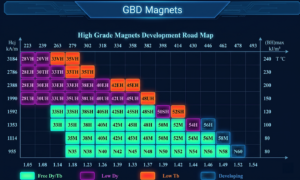
This is where it gets practical. Not every NdFeB grade is controlled — only those containing Dy or Tb. Whether your grade is affected depends almost entirely on its temperature class.
These grades ship freely — no license needed:
| Series | Max Working Temp | Grades |
|---|---|---|
| N | 80°C | N35 – N52 |
| M | 100°C | 35M – 52M |
| H | 120°C | 33H – 52H |
| SH | 150°C | 33SH – 48SH |
If your application runs below 150°C and you’re in this range, you’re fine. No change to your lead time.
These grades now require an export license:
| Series | Max Working Temp | Status |
|---|---|---|
| SH (upper end) | 150°C | 50SH, 52SH — controlled |
| UH | 180°C | All grades — controlled |
| EH | 200°C | All grades — controlled |
| TH / VH | 230–240°C | All grades — controlled |
If you’re running UH or EH grades — which covers most elevator motors, high-performance servo drives, and wind generators — you’re in the affected group.
What We’ve Seen on the Ground
One of our customers — a traction motor manufacturer in Turkey — had been buying N42UH for their elevator rotor arc segments without any issues for years. After April 2025, their order got held up in the licensing queue with no clear timeline. Their production schedule was built around a 30-day lead time. Suddenly they were looking at 12 weeks, minimum, with no certainty.
We sat down with their engineering team and went through their actual motor operating data. Their rotor winding temperature under full load had never exceeded 155°C. They had been specifying N42UH — rated to 180°C — largely out of habit and conservative margin.
We recommended switching to N42SHT. Same energy product, 160°C maximum operating temperature, and completely free of Dy/Tb. No export license required.
They reviewed the BH curves and temperature coefficient data we provided, approved the switch, and had parts on their floor 25 days after placing the order. No permits, no delays, no customs holds.
That’s not a unique situation. We’ve had similar conversations with motor OEM contacts in India, Germany, and across Southeast Asia since the controls took effect. The pattern is consistent: engineers specified UH or EH grades based on conservative estimates, never actually measured the operating temperature, and are now discovering there’s a Dy-free alternative that works perfectly well for their actual conditions.
If You Genuinely Need a Controlled Grade
Some applications do require UH or EH grades — there’s no viable substitute. If your motor genuinely runs hot, or if your design leaves very little thermal margin, a grade switch may not be an option.
In that case, the license process is manageable, but it has to be planned for.
What your supplier will need from you:
The most important document is the End-User and End-Use Certificate. This needs to be signed by your authorized representative — hand written signature, company seal, original copy. A scanned PDF of a typed signature won’t pass. You’ll also need a Chinese translation, confirmed accurate by your supplier.
The certificate needs to confirm three things: the magnets will only be used for the declared application, they won’t be transferred to third parties without Chinese government approval, and they won’t be used for weapons or WMD-related purposes.
Beyond that, your supplier needs a company introduction, copies of the purchase contract, and a technical description of the end application.
Realistic timeline:
Build 14–16 weeks into your planning. The statutory review period is 45 working days, but in practice it often runs longer. If your application triggers a State Council review — which can happen for sensitive end-uses — add more time.
One more thing worth knowing: if anything changes after the license is issued — the destination country, the end-user, the stated end-use — you need a new application and you have to stop shipments in the meantime. Make sure your contract reflects this.
Three Things Worth Doing Before Your Next Order
First, check your grade against the table above. If you’re on UH or EH, you’re affected. If you’re on SH, check whether it’s 50SH or 52SH — those are also controlled.
Second, find out what temperature your application actually runs at. If you’ve never measured rotor winding temperature under full load, it’s worth doing. A lot of UH specifications were set conservatively and have never been validated against real operating data. If your motor runs below 150°C in practice, N48SH or a similar Free Dy/Tb grade may be a straightforward substitution.
Third, if you’re on a controlled grade, start the license process before you need it. Don’t place an order and then apply for the permit. Start the paperwork 16 weeks before your target delivery date, and have a backup grade identified in case the license is delayed.
The Bigger Picture
This policy isn’t going away. China controls roughly 85–90% of global NdFeB magnet production, and the heavy rare earth elements used in high-temperature grades are an even more concentrated supply chain. Export controls on these materials are a long-term structural reality, not a temporary disruption.
The buyers who adapt fastest are the ones reviewing their grade specifications now — not when their next shipment gets held at customs.
If you want a second opinion on whether your current grade has a viable Dy-free substitute, send us your grade, your operating temperature, and your application type. We’ll give you an honest answer within 24 hours — even if the answer is that you genuinely need the controlled grade.